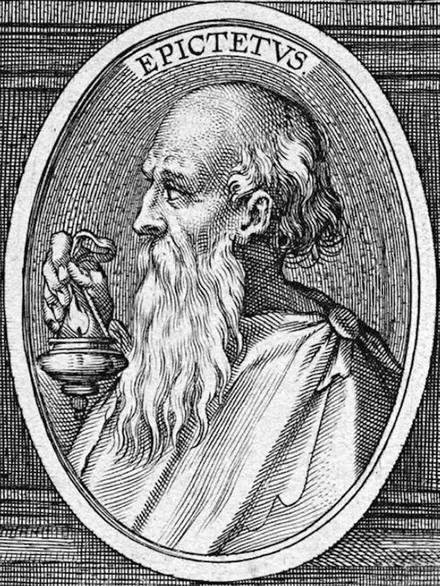
Epictetus in the primary texts
“I must die. Must I then die lamenting?”
Discourses I.1, trans. George Long
Dying is fixed; dying while lamenting is not. This short exchange comes from the opening chapter of the Discourses, which sorts what is in our power from what is not. Separating the fact from the complaint piled on top of it does not make death smaller, only the moaning.
“Keep by every means what is your own; do not desire what belongs to others.”
Discourses I.25, trans. George Long
For Epictetus the list of what is truly yours is short: your judgment and your choices, not a neighbour's house or a rival's career. Those you are to keep by every means, and what belongs to others you are not even to desire. Comparison breaks that second half many times an hour, usually without being noticed.
“For in these matters we must not believe the many, who say that free persons only ought to be educated, but we should rather believe the philosophers who say that the educated only are free.”
Discourses II.1, trans. George Long
Most people say only the free should be educated; the philosophers, Epictetus replies, say only the educated are free. For a teacher who was born a slave and later freed, the reversal is personal. Freedom here means a trained mind that can judge clearly, something no legal status supplies on its own.
“Every habit and faculty is maintained and increased by the corresponding actions: the habit of walking by walking, the habit of running by running.”
Discourses II.18, trans. George Long
Habits, on this account, are built the way legs are: walking keeps up walking, running keeps up running, and every faculty grows by its own exercise. Anger fed now is stronger later, and so is patience practised now. That is good news and bad news at once, since each small action counts toward the person you are becoming.
“Know you not that a good man does nothing for the sake of appearance, but for the sake of doing right?”
Discourses III.24, trans. George Long
Appearance is not a motive a good person acts on; doing right is. Epictetus puts it as a question, as if any student ought to know the answer already. The real test is what you would still do if no one could ever find out.
“Do you seek a reward for a good man greater than doing what is good and just?”
Discourses III.24, trans. George Long
Reward-seeking is turned on its head in this question from the same discourse: what greater reward could a good person want than doing what is good and just? Help given in exchange for thanks will often leave you feeling cheated. Help given for its own sake has already been paid in full.
“When you have remitted your attention for a short time, do not imagine this, that you will recover it when you choose; but let this thought be present to you, that in consequence of the fault committed today your affairs must be in a worse condition for all that follows.”
Discourses IV.12, trans. George Long
Attention, once let slip, does not come back on command. Epictetus warns that a fault committed today leaves your affairs in a worse condition for all that follows, so the plan of relaxing now and recovering later is itself the mistake. When you notice the drift, return at once rather than tomorrow.
“If you love an earthen vessel, say it is an earthen vessel which you love; for when it has been broken you will not be disturbed.”
Enchiridion III, trans. George Long
Calling a clay cup a clay cup sounds trivial, yet it draws the line between loving a thing and being shocked by its nature. Say in advance that it can break, and its breaking will not disturb you. Some readers find this cold; Epictetus would answer that the love stays and only the shock goes.
“It is the act of an ill-instructed man to blame others for his own bad condition; it is the act of one who has begun to be instructed, to lay the blame on himself; and of one whose instruction is completed, neither to blame another, nor himself.”
Enchiridion V, trans. George Long
Three stages of growth fit into one sentence: the untaught blame others for their bad condition, the learner blames himself, and the fully instructed blames neither. Most of us live in the middle stage and call it maturity. Epictetus counts self-blame as progress, but only as the halfway point.
“Disease is an impediment to the body, but not to the will, unless the will itself chooses.”
Enchiridion IX, trans. George Long
Illness can stop the body without stopping the will, unless the will gives way of its own accord. This comes from a teacher who was himself lame, so it is not advice from someone who never hurt. On a bad health day the real question is which choices are still open.
“Wish to be considered to know nothing; and if you shall seem to some to be a person of importance, distrust yourself.”
Enchiridion XIII, trans. George Long
Being thought ignorant is the price Epictetus asks a learner to accept, and if people start treating you as important, he says, distrust yourself. He gives no reason, but one is easy to supply: a reputation quickly becomes the thing you protect instead of the truth. It pairs with the Socrates line near the end of the handbook: aim high, and never assume you have arrived.
“He is the master of every man who has the power over the things which another person wishes or does not wish, the power to confer them on him or to take them away.”
Enchiridion XIV, trans. George Long
Anyone who can give or take away what you want or fear is, in his blunt word, your master. Coming from a man who had actually been owned by another, the word is not a figure of speech. Every wish that depends on someone else's gift hands them a little of that power.
“For this is your duty, to act well the part that is given to you; but to select the part, belongs to another.”
Enchiridion XVII, trans. George Long
Your duty is to act well the part you are given; choosing the part belongs to another. The image comes from the theatre, where a good actor plays the beggar as carefully as the king. Family, body, work and era are the role, and only the playing of it is marked as yours.
“You can be invincible, if you enter into no contest in which it is not in your power to conquer.”
Enchiridion XIX, trans. George Long
Invincibility, on these terms, comes from refusing every contest you cannot win by your own power. Promotions, rankings and other people's opinions are such contests, since someone else always decides them. Honesty, effort and the way you answer events are the fights no one else can score.
“Remember that it is not he who reviles you or strikes you, who insults you, but it is your opinion about these things as being insulting.”
Enchiridion XX, trans. George Long
Neither the abuse nor the blow is what insults you, Epictetus insists, but your opinion that they are insulting. He means this at full strength, not as a tip for staying calm. If the harm lies in your judgment, so does the power to refuse it, which is why the handbook returns to the idea ten sections later, widened to every kind of damage.
“Let death and exile and every other thing which appears dreadful be daily before your eyes; but most of all death: and you will never think of anything mean nor will you desire anything extravagantly.”
Enchiridion XXI, trans. George Long
Death, exile and every other dreaded thing are meant to stay before your eyes daily, and death most of all. The promise is precise: with that view in place you will never think anything mean nor desire anything extravagantly. It works less as a gloomy exercise than as a way of shrinking small worries to their real size.
“If it should ever happen to you to be turned to externals in order to please some person, you must know that you have lost your purpose in life.”
Enchiridion XXIII, trans. George Long
Turning to outside things just to please some person means, in his words, that you have lost your purpose in life. That is not a mild warning about people-pleasing; it treats the slide as a loss of direction altogether. Watch for the moment a choice is made mainly to win one particular person's favour.
“If any person was intending to put your body in the power of any man whom you fell in with on the way, you would be vexed; but that you put your understanding in the power of any man whom you meet, so that if he should revile you, it is disturbed and troubled, are you not ashamed at this?”
Enchiridion XXVIII, trans. George Long
Nobody would hand their body to the first stranger met on the road, yet we hand our understanding to anyone who reviles us and let it be thrown into turmoil. Epictetus ends with a question rather than a rule, asking whether we are not ashamed of this. The shame is the point, and he leaves it with the reader.
“For another will not damage you, unless you choose: but you will be damaged then when you shall think that you are damaged.”
Enchiridion XXX, trans. George Long
Another person cannot damage you unless you choose; you are damaged at the moment you think you are. Read alongside the earlier section on insults, this widens the claim from words and blows to every kind of harm. It does not excuse the one who acts badly, but it puts the deciding judgment back with you.
“Immediately prescribe some character and some form to yourself, which you shall observe both when you are alone and when you meet with men.”
Enchiridion XXXIII, trans. George Long
Prescribe a character for yourself immediately, he says, and keep it both alone and in company. The word immediately matters: the standard is fixed before temptation arrives, not bargained over in the moment. Many people run two selves, one private and one public, and this section asks for a single one.
“In company take care not to speak much and excessively about your own acts or dangers; for as it is pleasant to you to make mention of your own dangers, it is not so pleasant to others to hear what has happened to you.”
Enchiridion XXXIII, trans. George Long
Stories of our own deeds and dangers are pleasant to tell and much less pleasant to hear. This small piece of conversational manners sits in the same section as the call to set yourself a character and keep it alone and in company, which shows how practical the handbook can be. Before the next long anecdote, notice who in the room is still listening.
“When you have decided that a thing ought to be done, and are doing it, never avoid being seen doing it, though the many shall form an unfavorable opinion about it.”
Enchiridion XXXV, trans. George Long
Once you have decided a thing ought to be done, never avoid being seen doing it, even if the many think badly of it. Hiding a right action quietly admits the crowd still has a vote. And if the decision was wrong, the cure is to change the decision, not to carry it out in secret.
“If you have assumed a character above your strength, you have both acted in this manner in an unbecoming way, and you have neglected that which you might have fulfilled.”
Enchiridion XXXVII, trans. George Long
Taking on a role above your strength costs you twice: you play it in an unbecoming way, and you neglect the one you could have filled. Ambition is not the target here; misjudging your own measure is. Turning down the wrong task can be the condition for doing the right one well.
“When any person treats you ill or speaks ill of you, remember that he does this or says this because he thinks that it is his duty.”
Enchiridion XLII, trans. George Long
Whoever treats you badly or speaks ill of you does it, Epictetus says, because they think it is their duty. He does not say they are right. They are following what seems right to them, which makes them mistaken rather than malicious, and a mistake is far easier to meet without anger than an attack.
“Everything has two handles, the one by which it may be borne, the other by which it may not.”
Enchiridion XLIII, trans. George Long
Everything has two handles, one by which it can be borne and one by which it cannot. The event stays the same; the grip changes. Take hold of a quarrel with a relative by the wrong that was done and it cannot be carried; take hold of it by the shared history and often it can.
“These reasonings do not cohere: I am richer than you, therefore I am better than you; I am more eloquent than you, therefore I am better than you.”
Enchiridion XLIV, trans. George Long
Richer, therefore better; more eloquent, therefore better: Epictetus says such reasonings do not cohere. All that follows is that one person's money or speech is better than another's. The person is being confused with what they own, an error as easy to make about yourself as about anyone else.
“And if you ever wish to exercise yourself in labor and endurance, do it for yourself, and not for others.”
Enchiridion XLVII, trans. George Long
Training in labour and endurance should be done for yourself, not for others. In an age of shared workout logs and public fasting challenges, the line cuts close. Discipline performed for an audience mostly trains the wish to be watched, not the body or the will it claims to strengthen.
“The condition and characteristic of a philosopher is this: he expects all advantage and all harm from himself.”
Enchiridion XLVIII, trans. George Long
Philosophers, by his definition, expect all advantage and all harm from themselves. Set beside the breakable cup and the sting of insults elsewhere on this page, this is where the handbook's threads meet: good and bad happen in our own judgments. It is a demanding standard, because it leaves no one else to blame.
“And whatever any man shall say about you, do not attend to it; for this is no affair of yours.”
Enchiridion L, trans. George Long
What anyone says about you is, Epictetus says flatly, no affair of yours. It is a release as much as a rule, since keeping track of every opinion is endless work. Right beside this line in the same section of the handbook comes the Socrates passage, which shows where the freed attention is meant to go.
“But you, though you are not yet a Socrates, ought to live as one who wishes to be a Socrates.”
Enchiridion L, trans. George Long
Near the end of the handbook Epictetus turns to the reader directly and grants the obvious: you are not yet a Socrates. That is expected; what is asked is to live as one who wishes to be a Socrates. Wanting the standard, and acting from that wish, already changes small choices long before the goal is reached, so choose a model worth growing toward and let it settle the next hard decision.