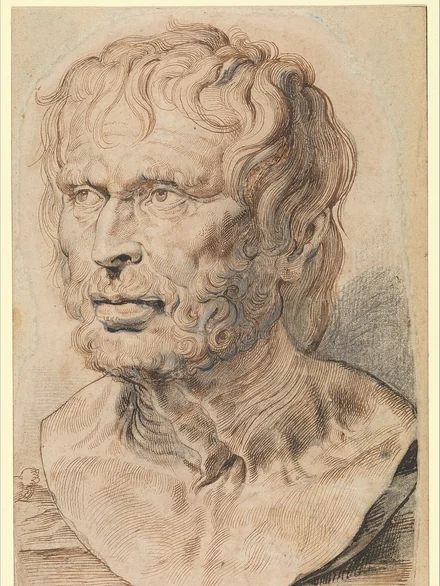
Seneca in the primary texts
“Everything, Lucilius, belongs to others; time alone is ours. Nature has put us in possession of this one fleeting and slippery thing, and anyone who wishes can drive us out of it.”
Letters to Lucilius 1.3
Your time is the one thing truly yours, yet anyone who wants it can take it. That makes every meeting, scroll and favour a small handover of something that cannot be bought back. This is the opening letter to Lucilius, and the collection keeps returning to the same worry about where the hours go.
“Poverty that is cheerful is no poverty at all; it is not the one who has too little, but the one who craves more, who is poor.”
Letters to Lucilius 2.6
Poverty, on this view, is measured by wanting rather than by the size of a bank balance. Someone with little who wants little is not poor; someone with plenty who keeps craving more is. Seneca makes the same point to his mother from exile, where he writes that nature can be satisfied even with scant measure.
“It is your mind you must change, not your sky. Though you have crossed the wide sea, though, as our Virgil says, “lands and cities fall away behind,” your faults will follow you wherever you arrive.”
Letters to Lucilius 28.1
Moving to a new city, job or partner changes the sky and leaves the mind as it was, because your faults follow you wherever you arrive. Writing to Lucilius, Seneca even borrows a line of Virgil about lands and cities falling away behind, only to insist that the mind is what must change. Hard words for anyone planning an escape, though they also mean the real change can begin without moving at all.
“As with a play, so with life: what matters is not how long it runs, but how well it is acted.”
Letters to Lucilius 77.20
Seneca treats a life like a play: the length of the run matters less than how well it is acted. A shorter life lived with care beats a long one spent drifting. In this way the letter answers the person in On the Shortness of Life who has not lived long but has only been long alive.
“It is not because things are difficult that we do not dare; it is because we do not dare that they are difficult.”
Letters to Lucilius 104.26
Here the usual order is turned around: we call a task hard because we do not dare, and it stays hard for the same reason, so fear produces the difficulty instead of following from it. The reversal pairs with the warning in On the Shortness of Life that putting off real living until later means beginning just as you have to leave.
“Thus it is: we do not receive a short life, but we make it a short one, and we are not poor in days, but wasteful of them.”
On the Shortness of Life I, trans. Aubrey Stewart
Most of us complain that life is short, but Seneca says the trouble is how we spend it: we are not poor in days, only wasteful of them. On this account the shortage is of care, not of time. The whole essay on the shortness of life grows out of this opening reversal.
“How late it is to begin life just when we have to be leaving it!”
On the Shortness of Life III, trans. Aubrey Stewart
Plenty of people plan to start living properly after retirement, after the kids leave, after one more promotion. Seneca finds that far too late: it means beginning just as you have to leave. Whatever you are postponing until later, ask what a small version of it would look like now.
“You have no grounds, therefore, for supposing that any one has lived long, because he has wrinkles or grey hairs: such a man has not lived long, but has only been long alive.”
On the Shortness of Life VII, trans. Aubrey Stewart
Grey hair proves that time has passed, not that a life was lived. Wrinkles, Seneca says, give no grounds for thinking someone has lived long; such a person has only been long alive. It is a blunt verdict on treating age itself as proof of a full life, and it sits in the same essay that blames our sense of a short life on how we spend it.
“Whither are you looking, whither are you stretching forward? everything future is uncertain: live now straightway.”
On the Shortness of Life IX, trans. Aubrey Stewart
Our eyes are always on next month or next year, yet everything in the future is uncertain, and Seneca's answer is to live now, without delay. In the same chapter he complains that we arrange our lives around what lies in the hands of Fortune while letting go of what lies in our own.
“Mankind is born for mutual assistance, anger for mutual ruin: the former loves society, the latter estrangement.”
On Anger I.V, trans. Aubrey Stewart
People are made to help each other, and anger works against that, pushing them apart. Seen this way, losing your temper is not just unpleasant but goes against what you are for. Later in On Anger the same thought returns as a short question about how much better it is to heal an injury than to avenge it.
“Many have taken small injuries much more seriously to heart than they need, by revenging them: that man is great and noble who like a large wild animal hears unmoved the tiny curs that bark at him.”
On Anger II.XXXII, trans. Aubrey Stewart
Small insults grow large mainly when we try to avenge them. Seneca pictures a large wild animal that hears tiny dogs barking at it and stays unmoved. The image flatters the reader a little, and that may be its point: dignity can be a stronger motive for calm than patience.
“Anger often comes to us, but we often go to it.”
On Anger III.XII, trans. Aubrey Stewart
Anger sometimes arrives uninvited, but often we walk straight toward it: rereading the rude email, replaying the argument, looking for offence. On Anger was addressed to Seneca's brother Novatus, and this short line is one of its most practical, because it moves part of the blame from the provocation to the person who went looking for it.
“How far better is it to heal an injury than to avenge it?”
On Anger III.XXVII, trans. Aubrey Stewart
Revenge keeps the wound open; healing closes it. Seneca asks a simple question and lets the answer speak. When someone has hurt you, put your effort into mending what was damaged, in yourself or the relationship, rather than into making them pay.
“Above all, however, avoid dismal men who grumble at whatever happens, and find something to complain of in everything.”
On Tranquillity of Mind VII, trans. Aubrey Stewart
Moods spread. Someone who grumbles at whatever happens slowly teaches you to do the same. Seneca gives this advice to Serenus, to whom the essay is addressed, in a chapter on choosing friends, where he warns that vices are contagious and pass from one person to the next.
“Know then that every station of life is transitory, and that what has ever happened to anybody may happen to you also.”
On Tranquillity of Mind XI, trans. Aubrey Stewart
No station in life is permanent, and anything that has happened to anyone may happen to you. Read as a threat, the line only frightens. Seneca means it as preparation: a little earlier in the same chapter he says it is too late to train the mind for hardship once the danger has already arrived.
“Men’s minds ought to have relaxation: they rise up better and more vigorous after rest.”
On Tranquillity of Mind XVII, trans. Aubrey Stewart
Rest is not laziness. Minds, Seneca says, ought to have relaxation, and they rise up better and more vigorous after it. If you treat time off as wasted, you may be wearing yourself down; build real pauses into the week and you will often work better when you return.
“It does not matter what you bear, but how you bear it.”
On Providence II, trans. Aubrey Stewart
We cannot always choose our burdens, but we can choose how we carry them. What we bear does not matter, Seneca says; how we bear it does. On Providence was addressed to Lucilius, the same friend who receives the letters, and this one line is close to a summary of the whole essay.
“Do not, I beg you, dread those things which the immortal gods apply to our minds like spurs: misfortune is virtue’s opportunity.”
On Providence IV, trans. Aubrey Stewart
Hard times, Seneca insists, are not to be dreaded: they are spurs the gods apply to our minds, and misfortune is virtue's opportunity. It becomes a chance to practise courage, patience and fairness. A chapter later, On Providence puts the same idea as gold tried by fire.
“Fire tries gold, misfortune tries brave men.”
On Providence V, trans. Aubrey Stewart
Fire proves gold, and misfortune proves the brave: you only learn how steady you are when something goes wrong. The image comes a chapter after Seneca's claim in On Providence that misfortune is virtue's opportunity, and together the two lines treat hardship as a trial of character rather than a punishment.
“I am not a wise man, and I will not be one in order to feed your spite: so do not require me to be on a level with the best of men, but merely to be better than the worst: I am satisfied, if every day I take away something from my vices and correct my faults.”
On the Happy Life XVII, trans. Aubrey Stewart
Answering critics who mock him for not living as he teaches, Seneca admits he is no sage: he asks only to be counted better than the worst, and is content if each day removes something from his vices. That is a goal anyone can reach. Forget perfection and pick one small bad habit to chip away at.
“I will do nothing because of public opinion, but everything because of conscience: whenever I do anything alone by myself I will believe that the eyes of the Roman people are upon me while I do it.”
On the Happy Life XX, trans. Aubrey Stewart
Conscience, not public opinion, is to decide what Seneca does, and when alone he will act as if the eyes of the Roman people were on him. The two halves seem to pull apart but meet in one demand: be the same person in private as in public. Written around the time a senator was publicly attacking his fortune, it reads as a promise others could check.
“In fine, my riches belong to me, you belong to your riches.”
On the Happy Life XXII, trans. Aubrey Stewart
Owning things is fine; being owned by them is the trap. Seneca draws the line in one short sentence. It is also self-defence from a very rich man, and a reader is free to ask whether the claim is easier to make when the coffers are full.
“Now clemency becomes no one more than a king or a prince; for great power is glorious and admirable only when it is beneficent; since to be powerful only for mischief is the power of a pestilence.”
On Clemency I.3, trans. Aubrey Stewart
Power deserves admiration only when it does good; power used only for harm is the power of a plague. Seneca wrote On Clemency for the young Nero, soon after the murder of Britannicus, which makes the compliment to rulers sound very much like a warning.
“Pity considers a man’s misfortunes and does not consider to what they are due: mercy is combined with reason.”
On Clemency II.5, trans. Aubrey Stewart
Pity reacts to suffering without asking why it happened; mercy is combined with reason. Seneca wants compassion that thinks. Addressed to an emperor who held the power of pardon, the distinction was practical: a ruler moved by pity alone would free the guilty along with the unlucky.
“The rule for the giver and receiver of a benefit is, that the one should straightway forget that he has given, the other should never forget that he has received it.”
On Benefits II.X, trans. Aubrey Stewart
A good gift has two rules: the giver forgets it at once and the receiver never forgets it. Keeping score as a giver spoils the gift; forgetting help you received spoils the friendship. Let go of the favours you have done, and hold on to the ones done for you.
“There is no one so highly placed by fortune as not to want a friend all the more because he wants nothing.”
On Benefits VI.XXIX, trans. Aubrey Stewart
Even people who have everything need a friend, all the more because they want nothing else. Success does not replace companionship. The line cuts against the habit of offering help only in a crisis, since the people least often asked how they are doing may be the ones who look most secure.
“We ought frequently to remind ourselves that we must love the things of this life as we would what is shortly to leave us, or indeed in the very act of leaving us.”
Of Consolation: To Marcia X, trans. Aubrey Stewart
Love what you have as if it were already on its way out. This is not a call to gloom but to attention: people and things are dearer when we remember they will not last. Written to console Marcia, it looks forward as well as back, meant to soften the next loss and not only the last one.
“Now every evil is just as great as we consider it to be: we have, therefore, the remedy in our own hands.”
Of Consolation: To Marcia XIX, trans. Aubrey Stewart
Every evil, Seneca tells Marcia, is just as great as we consider it to be, so the remedy is in our own hands. To someone grieving that can sound harsh. He means it as good news: what our judgment has made larger, our judgment can also make smaller.
“Nothing is sufficient for covetous desire, but Nature can be satisfied even with scant measure.”
Of Consolation: To Helvia X, trans. Aubrey Stewart
Greed can never be satisfied, but nature is content with very little. Seneca wrote this from exile on Corsica to console his mother Helvia, so the claim that little is enough comes from someone who had lost his place in Rome.
“The invulnerable is not that which is never struck, but that which is never wounded.”
On the Firmness of the Wise Man III, trans. Aubrey Stewart
Being strong does not mean never being hit; it means not being wounded by the blow. Insults, setbacks and losses will come. The goal is not to avoid every strike but to keep your character intact when one lands.