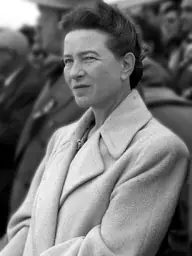
 Simone de Beauvoir1908 – 1986
“One is not born, but rather becomes, a woman.”
In Simone de Beauvoir's voice — an AI reflection
This means that womanhood is not a fixed essence handed to us at birth, but a dynamic creation shaped by society, history, and our own choices. It is a becoming, a process of negation and assertion, where we both resist the roles imposed upon us and carve out our own existence. The phrase underscores that freedom and constraint are intertwined in the fabric of identity. We are not passive recipients of our fate, but active participants in its making.
What does this quote mean?
Few ideas have reshaped modern thought as thoroughly as the notion that gender is not a fixed essence but a lived experience. Simone de Beauvoir’s assertion strips away the myth of innate femininity, framing womanhood as a social construction shaped by history, culture, and personal choice. It challenges the assumption that biology alone dictates identity, inviting us to see gender as a process of becoming rather than a static state.
Beauvoir wrote these words in The Second Sex, published in 1949, a period when existentialism was at its peak and feminist discourse was gaining momentum. As a philosopher deeply influenced by Sartre’s existentialist framework, she argued that women, like all humans, are free agents who define themselves through action. In an era when women’s roles were narrowly prescribed, her work exposed how societal norms limit this freedom, forcing women into the confines of the "Other"—a category defined in relation to men, not on its own terms. The Ethics of Ambiguity further explores this tension, emphasizing the ethical responsibility of embracing one’s freedom while acknowledging the constraints imposed by others.
Today, Beauvoir’s insight resonates in debates about gender fluidity, workplace equality, and personal autonomy. A young professional navigating a male-dominated field might find empowerment in recognizing that her identity isn’t predetermined but crafted through her choices and resilience. Similarly, parents raising children can reject rigid stereotypes, allowing their daughters and sons to explore their interests without the weight of traditional expectations. The quote reminds us that while society may assign roles, the power to redefine them lies in our hands.
Frequently asked questions
Who said “One is not born, but rather becomes, a woman.”?
“One is not born, but rather becomes, a woman.” is by Simone de Beauvoir.
More quotes by Simone de Beauvoir
- “Few tasks are more like the torture of Sisyphus than housework, with its endless repetition: the clean becomes soiled, the soiled is cleaned, over and over, day after day.”
- “To ‘catch’ a husband is an art; to ‘hold’ him is a job — and one in which great competence is called for.”
- “To will oneself free is also to will others free.”
Which philosopher are you?
Six questions. No wrong answers.
Keep Simone de Beauvoir in your pocket
Sagius is free to download and gives you 5 free credits, +5 when you sign up, to try the AI features — chat with Simone de Beauvoir and other great philosophers, and have any quote explained with the meaning behind it.