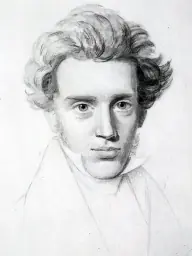
 Søren Kierkegaard1813 – 1855
“The greatest hazard of all, losing one's self, can occur very quietly in the world, as if it were nothing at all.”
In Søren Kierkegaard's voice — an AI reflection
This is the quiet tragedy of the spirit: we may become so absorbed in the noise of daily life, in the roles we play and the expectations we meet, that we forget we were ever anything more. The self does not vanish in a single dramatic moment but fades, like a face in a crowd that slowly turns away, until one day we no longer recognize ourselves. It is not the grand failures that undo us, but the slow surrender of our inwardness to the outward. To lose oneself is to live as a shadow of what one might have been.
What does this quote mean?
A quiet erosion of the self can be more devastating than any dramatic downfall. Kierkegaard’s warning uncovers how easily identity dissolves not through grand tragedies but through passive conformity, the slow surrender to external expectations until one no longer recognizes their own desires or convictions. The danger lies in its invisibility—like a river carving stone, the loss happens gradually, masked as normalcy, until the person is no longer the author of their life but a ghost in someone else’s script.
This concern sat at the heart of Kierkegaard’s project in the 1840s, a decade when Denmark’s cultural and religious currents pushed toward homogeneity. In works like The Sickness Unto Death, he dissected the despair of the self that either refuses to be itself or clings too tightly to finite roles, losing its infinite potential. His pseudonyms in Either/Or and the knight of faith in Fear and Trembling are not just literary devices but existential experiments, each probing how authenticity is won or forfeited. For Kierkegaard, the modern age’s greatest peril was not outright oppression but the subtle anesthesia of the spirit, where individuals mistake societal roles for genuine selfhood.
Today, the hazard feels even more pressing in an era of curated identities and algorithmic validation. The quiet loss of self shows up in the way social media nudges us to perform rather than reflect, or how career ladders can replace inner calling. To resist, Kierkegaard would urge small, deliberate acts of self-reclamation: journaling to confront one’s true thoughts, choosing solitude over constant connectivity, or rejecting the pressure to have an opinion on everything. Authenticity isn’t a grand gesture but a daily vigilance against the slow fade into what others expect, a commitment to ask not just what the world demands of you, but what you demand of yourself.
Frequently asked questions
Who said “The greatest hazard of all, losing one's self, can occur…”?
“The greatest hazard of all, losing one's self, can occur…” is by Søren Kierkegaard.
More quotes by Søren Kierkegaard
- “The greatest danger, that of losing one's own self, may pass off as quietly as if it were nothing; every other loss, that of an arm, a leg, five dollars, a wife etc., is sure to be noticed.”
- “The thing is to understand myself, to see what God really wishes me to do: the thing is to find a truth which is true for me, to find the idea for which I can live and die.”
- “The human being is spirit. But what is spirit? Spirit is the self. But what is the self? The self is a relation which relates itself, or that in the relation which is its relating to itself.”
Which philosopher are you?
Six questions. No wrong answers.
Keep Søren Kierkegaard in your pocket
Sagius is free to download and gives you 5 free credits, +5 when you sign up, to try the AI features — chat with Søren Kierkegaard and other great philosophers, and have any quote explained with the meaning behind it.