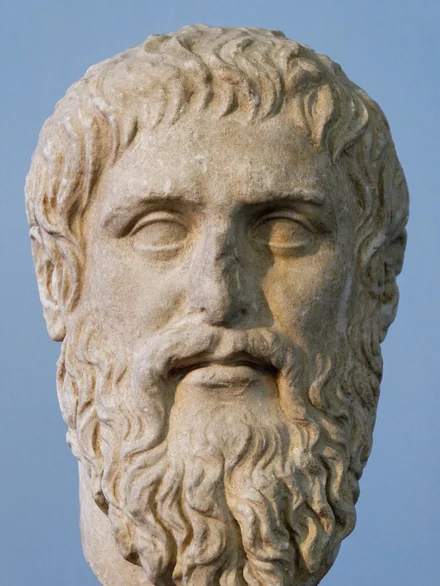
Plato
428 BC – 348 BC
Plato (c. 428–348 BCE) was a student of Socrates and teacher of Aristotle — and arguably the most influential philosopher in Western history. His dialogues explore the nature of justice, beauty, truth, love, and knowledge through the character of Socrates. In The Republic, he proposed a utopian city governed by philosopher-kings, grounded in his Theory of Forms: the idea that the material world is a shadow of eternal, unchanging realities accessible only to reason.
Key works: The Republic · Symposium · Phaedrus · Allegory of the Cave
Themes
Top quotes by Plato
“Bodily exercise, when compulsory, does no harm to the body; but knowledge which is acquired under compulsion obtains no hold on the mind.”
Read the full explanation →“For he whose happiness rests with himself, if possible, wholly, and if not, as far as is possible,--who is not hanging in suspense on other men, or changing with the vicissitude of their fortune,--has his life ordered for the best.”
Read the full explanation →“Moreover, there is a victory and defeat--the first and best of victories, the lowest and worst of defeats--which each man gains or sustains at the hands, not of another, but of himself; this shows that there is a war against ourselves going on within every one of us.”
Read the full explanation →“The greatest blessing granted to mankind comes by way of madness, which is a divine gift.”
Read the full explanation →“Do not all men, my dear sir, desire good?”
Meno, Soc 59, trans. Benjamin Jowett
Read the full explanation →“Neither do the ignorant seek after wisdom.”
Symposium 8.2, trans. Benjamin Jowett
Read the full explanation →“I mean that courage is a kind of salvation.”
Republic IV, trans. Benjamin Jowett
Read the full explanation →“For is not philosophy the practice of death?”
Phaedo L2695, trans. Benjamin Jowett
Read the full explanation →“O my friend, how prophetic is the human soul!”
Phaedrus 242c, trans. Benjamin Jowett
Read the full explanation →“But virtue, as I suspect, could not be taught.”
Meno, Soc 229, trans. Benjamin Jowett
Read the full explanation →
Which philosopher are you?
Six questions. No wrong answers.
Keep Plato in your pocket
Sagius is free to download and gives you 5 free credits, +5 when you sign up, to try the AI features — chat with Plato and other great philosophers, and have any quote explained with the meaning behind it.