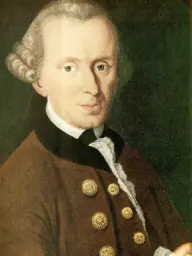
 Immanuel Kant1724 – 1804
“All our knowledge begins with the senses, proceeds then to the understanding, and ends with reason. There is no other source.”
In Immanuel Kant's voice — an AI reflection
This is my attempt to trace the path of human cognition as it ascends from the raw impressions of the world to the structured grasp of its principles. The senses give us the material, the understanding shapes it into coherent experience, and reason, at last, seeks the universal laws that bind it all. Yet even reason must begin with what is given, for without the senses, the mind would have no content to think upon. The journey is from the particular to the universal, and it is the only road we have.
What does this quote mean?
Immanuel Kant’s assertion captures a foundational principle of his epistemology: human cognition is a structured process, not a passive reception of raw data. Sensory experience provides the initial input, but true knowledge emerges only when the understanding organizes this input through categories like causality and substance, and reason then unifies these into a coherent system. This hierarchical model rejects the idea that knowledge can arise from pure intuition or divine revelation alone, insisting instead on the active role of the mind in shaping what we know.
Written in the late 18th century during the Enlightenment, this line from the Critique of Pure Reason reflects Kant’s response to the empirical and rationalist traditions that dominated his era. Empiricists like Hume argued that knowledge comes solely from experience, while rationalists like Leibniz claimed reason alone could grasp truth. Kant synthesized these views, proposing that while the senses supply the material, the mind’s innate structures—such as space, time, and the categories of understanding—give it form. This was revolutionary, positioning human cognition as both receptive and constructive, a middle path that defined his transcendental idealism.
For today’s learner, Kant’s insight offers a practical framework for critical thinking. In an age of information overload, it’s easy to take sensory input—news, social media, personal observations—at face value. But Kant reminds us that understanding requires more than passive absorption; it demands active engagement, categorization, and reasoning. Whether analyzing data, evaluating arguments, or simply reflecting on daily experiences, we can apply this model by first gathering observations, then organizing them logically, and finally testing their consistency within a broader rational framework. This disciplined approach turns raw information into meaningful knowledge.
Frequently asked questions
Who said “All our knowledge begins with the senses, proceeds then to…”?
“All our knowledge begins with the senses, proceeds then to…” is by Immanuel Kant.
More quotes by Immanuel Kant
Which philosopher are you?
Six questions. No wrong answers.
Keep Immanuel Kant in your pocket
Sagius is free to download and gives you 5 free credits, +5 when you sign up, to try the AI features — chat with Immanuel Kant and other great philosophers, and have any quote explained with the meaning behind it.