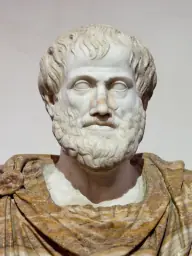
 Aristotle384 BC – 322 BC
“The soul never thinks without a mental picture.”
In Aristotle's voice — an AI reflection
The mind, like a painter, does not work with bare concepts but with images—shapes and colors drawn from the world it has known. Even when we reason about the highest things, we lean on the echoes of what we have seen or imagined. Thought is not a flight from the senses but a dance with them, for the soul weaves its understanding from the threads of experience. Without these pictures, we would be blind even in the brightest light of truth.
What does this quote mean?
Imagination is the silent partner of every thought, the unseen canvas on which reason paints its conclusions. Aristotle’s observation that the soul never thinks without a mental picture underscores how deeply perception and cognition are intertwined. Even abstract ideas, like justice or infinity, rely on images—whether literal or metaphorical—to take shape in the mind. Thinking, for him, is not a detached act but a vivid, almost sensory experience.
This insight emerges from Aristotle’s broader philosophical project in the 4th century BCE, where he sought to ground human understanding in the observable world. In works like Nicomachean Ethics and De Anima, he explores how the mind processes experience, arguing that knowledge begins with the senses and evolves through reflection. Unlike Plato, who often elevated pure reason above the material, Aristotle saw mental imagery as essential to reasoning itself, a bridge between the concrete and the conceptual. His era, marked by a fascination with logic and natural philosophy, provided the perfect backdrop for this empirical view of thought.
Today, we can apply this idea by recognizing the power of visualization in problem-solving and creativity. Whether designing a building, writing a novel, or planning a life goal, we often start with a mental image—a sketch, a scene, a vision. To think more clearly, we might even deliberately conjure vivid pictures, using imagination as a tool to sharpen our ideas. In a world saturated with digital abstractions, Aristotle’s reminder invites us to reclaim the tangible, the visual, and the human in our thinking.
Frequently asked questions
Who said “The soul never thinks without a mental picture.”?
“The soul never thinks without a mental picture.” is by Aristotle.
More quotes by Aristotle
- “Let us now summarize our results about soul, and repeat that the soul is in a way all existing things; for existing things are either sensible or thinkable, and knowledge is in a way what is knowable, and sensation is in a way what is sensible: in what way we must inquire.”
- “The happy life is thought to be virtuous; now a virtuous life requires exertion, and does not consist in amusement.”
- “The soul is the first principle of animal life.”
Which philosopher are you?
Six questions. No wrong answers.
Keep Aristotle in your pocket
Sagius is free to download and gives you 5 free credits, +5 when you sign up, to try the AI features — chat with Aristotle and other great philosophers, and have any quote explained with the meaning behind it.